
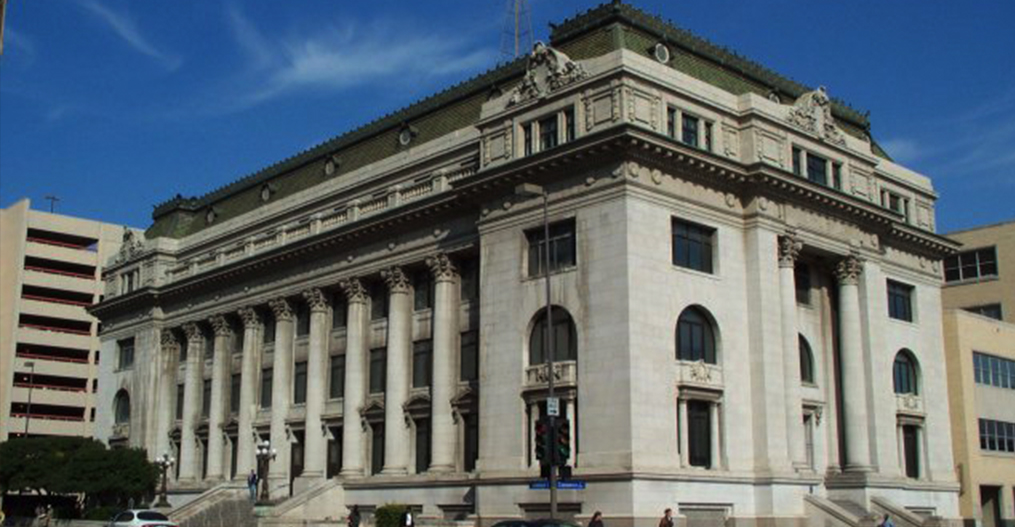
Dallas is a city in the U.S. state of Texas. With an estimated 2017 population of 1,341,075, it is the ninth most-populous city in the U.S. and third in Texas after Houston and San Antonio. Dallas is the main core of the largest metropolitan area in the Southern United States and the largest inland metropolitan area in the U.S. that lacks any navigable link to the sea. It is the most populous city in the Dallas–Fort Worth metroplex, the fourth-largest metropolitan area in the country at 7.3 million people as of 2017. Dallas is the seat of Dallas County. Sections of the city extend into Collin, Denton, Kaufman, and Rockwall counties.
Dallas and nearby Fort Worth initially developed due to the construction of major railroad lines through the area allowing access to cotton, cattle, and later oil in North and East Texas. The construction of the Interstate Highway System reinforced Dallas’s prominence as a transportation hub, with four major interstate highways converging in the city and a fifth interstate loop around it. Dallas then developed as a strong industrial and financial center, and a major inland port, due to the convergence of major railroad lines, interstate highways, and the construction of Dallas/Fort Worth International Airport, one of the largest and busiest airports in the world.
Dallas is rated a “beta(+)” global city. The economy of Dallas is considered diverse, with dominant sectors including defense, financial services, information technology, telecommunications, and transportation. It serves as the headquarters for 9 Fortune 500 companies within the city limits. The Dallas–Fort Worth metroplex hosts additional Fortune 500 companies, including American Airlines (Fort Worth), ExxonMobil (Irving), and J.C. Penney (Plano). The city has a population from a myriad of ethnic and religious backgrounds and the sixth-largest LGBT population in the United States.
History
In 1839, John Neely Bryan surveyed the area around present-day Dallas.[18] He established a permanent settlement near the Trinity River named Dallas in 1841. The origin of the name is uncertain. The official historical marker states it was named after Vice President George M. Dallas of Philadelphia, Pennsylvania. However, this is disputed. Other potential theories for the origin include his brother, Commodore Alexander James Dallas, as well as brothers Walter R. Dallas or James R. Dallas. A further theory gives the origin as the village of Dallas, Moray, Scotland, similar to the way Houston, Texas was named after Sam Houston whose ancestors came from the Scottish village of Houston, Renfrewshire. The Republic of Texas was annexed by the United States in 1845 and Dallas County was established the following year. Dallas was formally incorporated as a city on February 2, 1856.
With the construction of railroads, Dallas became a business and trading center and was booming by the end of the 19th century. It became an industrial city, attracting workers from Texas, the South, and the Midwest.
20th and 21st centuries
The Praetorian Building of 15 stories, built in 1909, was the first skyscraper west of the Mississippi and the tallest building in Texas for some time. It marked the prominence of Dallas as a city. A racetrack for thoroughbreds was built and their owners established the Dallas Jockey Club. Trotters raced at a track in Fort Worth, where a similar drivers club was based. The rapid expansion of population increased competition for jobs and housing.
In 1921, the Mexican president Álvaro Obregón along with the former revolutionary general visited Downtown Dallas’s Mexican Park in Little Mexico; the small park was on the corner of Akard and Caruth Street, site of the current Fairmount Hotel. The small neighborhood of Little Mexico was home to a Hispanic population that had been drawn to Dallas by factors including the American Dream, better living conditions, and the Mexican Revolution.[citation needed]
On November 22, 1963, President John F. Kennedy was assassinated on Elm Street while his motorcade passed through Dealey Plaza in Downtown Dallas. The upper two floors of the building from which alleged assassin Lee Harvey Oswald shot Kennedy, the Texas School Book Depository, have been converted into a historical museum covering the former president’s life and accomplishments.
On July 7, 2016, multiple shots were fired at a peaceful protest in Downtown Dallas, held against the police killings of two black men from other states. The gunman, later identified as Micah Xavier Johnson, began firing at police officers at 8:58 p.m., killing five officers and injuring nine. Two bystanders were also injured. This marked the deadliest day for U.S. law enforcement since the September 11 attacks. Johnson told police during a standoff that he was upset about recent police shootings of black men and wanted to kill whites, especially white officers. After hours of negotiation failed, police resorted to a robot-delivered bomb, killing Johnson inside El Centro College. The shooting occurred in an area of hotels, restaurants, businesses, and residential apartments only a few blocks away from Dealey Plaza.
Economy
In the 1980s Dallas was a real estate hotbed, with the increasing metropolitan population bringing with it a demand for new housing and office space. Several of Downtown Dallas’s largest buildings are the fruit of this boom, but over-speculation, the savings and loan crisis and an oil bust brought the 80’s building boom to an end for Dallas as well as its city sister Houston. Between the late 1980s and the early 2000s, central Dallas went through a slow period of growth. However, since the early 2000s the central core of Dallas has been enjoying steady and significant growth encompassing both repurposing of older commercial buildings in downtown Dallas into residential and hotel uses as well as the construction of new office and residential towers. The opening of Klyde Warren Park, built across Woodall Rodgers Freeway seamlessly connecting the central Dallas CBD to Uptown/Victory Park, has acted synergistically with the highly successful Dallas Arts District so both have become catalysts for significant new development in central Dallas.
The residential real estate market in the Dallas–Fort Worth metroplex has not only been resilient but has once again returned to a boom status. Dallas and the greater metro have been leading the nation in apartment construction and net leasing with rents reaching all-time highs. Single family home sales, whether pre-owned or new construction, along with home price appreciation are leading the nation.
A sudden drop in the price of oil, starting in mid-2014 and accelerating throughout 2015, has not significantly affected Dallas and its greater metro due to the highly diversified nature of its economy. Dallas, and the DFW metro, continue to see strong demand for housing, apartment and office leasing, shopping center space, warehouse and industrial space with overall job growth remaining very robust. Oil-dependent cities and regions have felt significant effects from the downturn but Dallas growth has continued unabated, strengthening in 2015. Significant national headquarters relocations to the area (as exemplified by Toyota’s decision to leave California and establish its new North American headquarters in the Dallas region) coupled with significant expansions of regional offices for a variety of corporations and along with company relocations to downtown Dallas are helping drive the current boom in the Dallas economy. Dallas leads Texas’s largest cities in Forbes’ 2015 ranking of “The Best Place for Business and Careers”
The Dallas–Fort Worth area has one of the largest concentrations of corporate headquarters for publicly traded companies in the United States. Fortune Magazine’s 2017 annual list of the Fortune 500 in America indicates the city of Dallas has 9 Fortune 500 companies,[91] and the DFW region as a whole has 22, reflecting the continued strong growth in the metro economy and up from 20 the year before. Dallas-Fort Worth now represents the largest concentration of Fortune 500 headquarters in the State of Texas, followed by Greater Houston with its count of 20, down from 24 the year before.
In 2008, AT&T relocated their headquarters to Downtown Dallas; AT&T is the largest telecommunications company in the world and the ninth largest company in the nation by revenue for 2017. Additional Fortune 500 companies headquartered in Dallas in order of ranking include Energy Transfer Equity, Tenet Healthcare, Southwest Airlines, Texas Instruments, Jacobs Engineering, HollyFrontier, Dean Foods, and Builders FirstSource. In October 2016, Jacobs Engineering, one of the world’s largest engineering companies, relocated from Pasadena, California to Downtown Dallas.
Irving is home to 6 Fortune 500 companies of its own, including ExxonMobil, the largest oil company in the world and the fourth largest company in the nation by revenue for 2017, Fluor (engineering), Kimberly-Clark, Celanese, Michaels Companies, and Vistra Energy.[91] Plano is home to 4 Fortune 500 companies including J.C. Penney, Alliance Data Systems, Yum China Holdings, and Dr. Pepper Snapple. Ft. Worth is home to 2 Fortune 500 companies including American Airlines, the largest airline in the world by revenue, fleet size, profit, passengers carried and revenue passenger mile and D.R. Horton, the largest homebuilder in America. One Fortune 500 company, Gamestop, is based in Grapevine.
Additional major companies headquartered in Dallas and its metro include Comerica, which relocated its national headquarters to Downtown Dallas from Detroit in 2007, NTT DATA Services, Regency Energy Partners, Atmos Energy, Neiman Marcus, Think Finance, 7-Eleven, Brinker International, Primoris Services, AMS Pictures, id Software, Ensco plc, Mary Kay Cosmetics, Chuck E. Cheese’s, Zale Corporation, and Fossil, Inc. Many of these companies—and others throughout the DFW metroplex—comprise the Dallas Regional Chamber.
Susan G. Komen for the Cure, the world’s largest breast cancer organization was founded and is headquartered in Dallas.
In addition to its large number of businesses, Dallas has more shopping centers per capita than any other city in the United States and is also home to the second shopping center ever built in the United States, Highland Park Village, which opened in 1931. Dallas is home of the two other major malls in North Texas, the Dallas Galleria and NorthPark Center, which is the 2nd largest mall in Texas. Both malls feature high-end stores and are major tourist draws for the region.
According to Forbes magazine’s annual list of “The Richest People in America” published September 21, 2011, the city is now home to 17 billionaires, up from 14 in 2009. In 2009 (with 14 billionaires) the city placed 6th worldwide among cities with the most billionaires. The ranking does not even take into account the 8 billionaires who live in the neighboring city of Fort Worth. In 2013, Forbes also ranked Dallas No. 13 on its list of the Best Places for Business and Careers.
Dallas is the third most popular destination for business travel in the United States, and the Kay Bailey Hutchison Convention Center is one of the largest and busiest convention centers in the country, at over 1,000,000 square feet (93,000 m2), and the world’s single-largest column-free exhibit hall.
Instructor
