
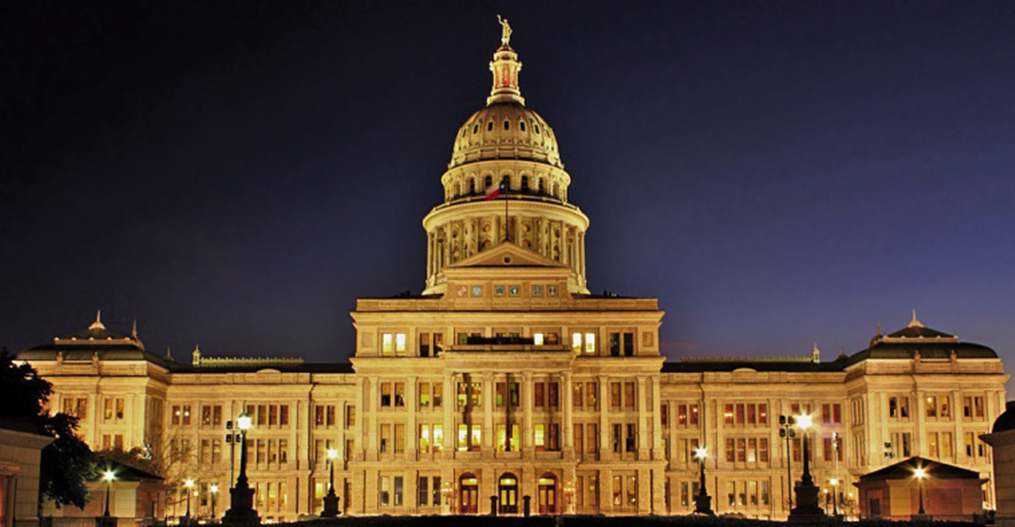
State government
Texas has a plural executive branch system limiting the power of the governor, which is a weak executive compared to some other states. Except for the Secretary of State, voters elect executive officers independently; thus candidates are directly answerable to the public, not the governor. This election system has led to some executive branches split between parties and reduced the ability of the governor to carry out a program. When Republican President George W. Bush served as Texas’s governor, the state had a Democratic lieutenant governor, Bob Bullock. The executive branch positions consist of the Governor, Lieutenant Governor, Comptroller of Public Accounts, Land Commissioner, Attorney General, Agriculture Commissioner, the three-member Texas Railroad Commission, the State Board of Education, and the Secretary of State.
The bicameral Texas Legislature consists of the House of Representatives, with 150 members, and a Senate, with 31 members. The Speaker of the House leads the House, and the lieutenant governor, the Senate The Legislature meets in regular session biennially for just over 100 days, but the governor can call for special sessions as often as desired (notably, the Legislature cannot call itself into session). The state’s fiscal year spans from the previous calendar year’s September 1 to the current year’s August 31. Thus, the FY 2015 dates from September 1, 2014 through August 31, 2015.
The judiciary of Texas is one of the most complex in the United States, with many layers and overlapping jurisdictions. Texas has two courts of last resort: the Texas Supreme Court, for civil cases, and the Texas Court of Criminal Appeals. Except for some municipal benches, partisan elections select judges at all levels of the judiciary; the governor fills vacancies by appointment. Texas is notable for its use of capital punishment, having led the country in executions since capital punishment was reinstated in the Gregg v. Georgia case (see Capital punishment in Texas).
The Texas Ranger Division of the Texas Department of Public Safety is a law enforcement agency with statewide jurisdiction. Over the years, the Texas Rangers have investigated crimes ranging from murder to political corruption. They have acted as riot police and as detectives, protected the Texas governor, tracked down fugitives, and functioned as a paramilitary force both for the republic and the state. The Texas Rangers were unofficially created by Stephen F. Austin in 1823 and formally constituted in 1835. The Rangers were integral to several important events of Texas history and some of the best-known criminal cases in the history of the Old West.
The Texas constitution defines the responsibilities of county governments, which serve as agents of the state. What are called commissioners court and court judges are elected to serve as the administrative arm. Most cities in the state, those over 5,000 in population, have home-rule governments. The vast majority of these have charters for council-manager forms of government, by which voters elect council members, who hire a professional city manager as operating officer.
Political history
In the 1870s, white Democrats wrested power back in the state legislature from the biracial coalition at the end of Reconstruction. In the early 20th century, the legislature passed bills to impose poll taxes, followed by white primaries; these measures effectively disfranchised most blacks, poor whites and Mexican Americans. In the 1890s, 100,000 blacks voted in the state; by 1906, only 5,000 could vote.[146] As a result, the Democratic Party dominated Texas politics from the turn of the century, imposing racial segregation and white supremacy. It held power until after passage in the mid-1960s of national civil rights legislation enforcing constitutional rights of all citizens.
Although Texas was essentially a one-party state during this time and the Democratic primary was viewed as “the real election,” the Democratic Party had conservative and liberal factions, which became more pronounced after the New Deal. Additionally, several factions of the party briefly split during the 1930s and 1940s.
The state’s conservative white voters began to support Republican presidential candidates by the mid-20th century. After this period, they supported Republicans for local and state offices as well, and most whites became Republican Party members. The party also attracted some minorities, but many have continued to vote for Democratic candidates. The shift to the Republican Party is much-attributed to the fact the Democratic Party became increasingly liberal during the 20th century, and thus increasingly out-of-touch with the average Texas voter. As Texas was always a conservative state, voters switched to the GOP, which now more closely reflected their beliefs. Commentators have also attributed the shift to Republican political consultant Karl Rove, who managed numerous political campaigns in Texas in the 1980s and 1990s.]Other stated reasons included court-ordered redistricting and the demographic shift in relation to the Sun Belt that favored the Republican Party and conservatism.
The 2003 Texas redistricting of Congressional districts led by Republican Tom DeLay, was called by The New York Times “an extreme case of partisan gerrymandering”.A group of Democratic legislators, the “Texas Eleven”, fled the state in a quorum-busting effort to prevent the legislature from acting, but was unsuccessful. The state had already redistricted following the 2000 census. Despite these efforts, the legislature passed a map heavily in favor of Republicans, based on 2000 data and ignoring the estimated nearly one million new residents in the state since that date. Career attorneys and analysts at the Department of Justice objected to the plan as diluting the votes of African American and Hispanic voters, but political appointees overrode them and approved it. Legal challenges to the redistricting reached the national Supreme Court in the case League of United Latin American Citizens v. Perry (2006), but the court ruled in favor of the state (and Republicans).
In the 2014 Texas elections, the Tea Party movement made large gains, with numerous Tea Party favorites being elected into office, including Dan Patrick as lieutenant governor, Ken Paxton as attorney general, in addition to numerous other candidates including conservative Republican Greg Abbott as governor.
Texas voters lean toward fiscal conservatism, while enjoying the benefits of huge federal investment in the state in military and other facilities achieved by the power of the Solid South in the 20th century. They also tend to have socially conservative values.
Since 1980, most Texas voters have supported Republican presidential candidates. In 2000 and 2004, Republican George W. Bush won Texas with respectively 59.3 and 60.1 percent of the vote, partly due to his “favorite son” status as a former governor of the state. John McCain won the state in 2008, but with a smaller margin of victory compared to Bush at 55 percent of the vote. Austin, Dallas, Houston, and San Antonio consistently lean Democratic in both local and statewide elections.
Residents of counties along the Rio Grande closer to the Mexico-United States border, where there are many Latino residents, generally vote for Democratic Party candidates, while most other rural and suburban areas of Texas have shifted to voting for Republican Party candidates.
As of the general elections of 2014, a large majority of the members of Texas’s U.S. House delegation are Republican, along with both U.S. Senators. In the 114th United States Congress, of the 36 Congressional districts in Texas, 24 are held by Republicans and 11 by Democrats. One seat is vacant. Texas’s Senators are John Cornyn and Ted Cruz. Since 1994, Texans have not elected a Democrat to a statewide office. The state’s Democratic voters are made up primarily by liberal and minority groups in Austin, Beaumont, Dallas, El Paso, Houston and San Antonio as well as minority voters in East and South Texas.
Instructor
